Building connections
Testing in accordance with guideline MO-01/1, ÖNORM 6400-2, VDPM information sheet
Building connections establish the connection between the building elements installed in wall openings and the building structure. They not only close the construction joint, but also seal this joint against weather and environmental influences. They therefore have the important function of protecting both the building structure and the building elements.
Properties
- Movement absorption
- Air permeability
- Water tightness against driving rain
- Temperature Change Loads
- Resistance to windload
Excerpt from the tests offered by the PfB
| Standard/Guideline | Description |
| MO-01/1 | Building connection of windows, Part 1 Method for determining the serviceability of sealing systems |
| ÖNORM B 6400-2 | External wall thermal insulation composite systems (WDVS) Part 2: Products, tests and requirements |
| VDPM | Information sheet: Design of details with profiles and joint sealing tapes for exterior plaster and WDVS |
Further tests for other building connection products, e.g. impregnated joint sealing tapes in accordance with DIN 18542, are available on request.
Comparing requirements for plaster sealing strips
| Test step | Ö-NORM 6400-2 | ift MO-01/1 | Merkblatt VDMP (Entwurf) |
| Visual Inspection | required | required | required |
| Water tightness against driving rain | up to 600 Pa | up to 600 Pa | up to min. 600 Pa |
| Air permeability | not required | up to 100 Pa (1) | – |
| Temperature Change Loads | 15 Cycles+55℃/-15℃ | 10 Cycles +60℃/-15℃ | – |
| Continuous operation | not required | 10.000 Cycles turn-tilt | – |
| Alternating wind load | 200 Cycles ±1000 Pa | 200 Cycles ±1000 Pa | – |
| Air permeability | not required | up to 1000 Pa (1) | – |
| Water tightness against driving rain | up to 600 Pa | up to 600 Pa | – |
| Visual Inspection | required | required | required |
| Disassembly | required | required | required |
| Movement Absorption | required | required | required according to MO-01/1 |
Water tightness against driving rain
The driving rain resistance of building connections is tested on a concrete test wall (1.8 x 2.0 m) with a window and ETICS installed. The window is fitted with the building connections to be tested. The amount of water and test duration are selected in accordance with DIN EN 1027. The maximum test pressure is +600 Pa.
Air permeability
The optional test of the air permeability of building connections is carried out on a concrete test wall (1.8 x 2.0 m) with a window and ETICS installed. The window is fitted with the building connections to be tested. The test duration for the individual pressure stages is selected in accordance with DIN EN 1026. The maximum test pressure is ±1,000 Pa.
Resistance to wind load
The resistance of building connections to wind load is tested on a concrete test wall (1.8 x 2.0 m) with a window and ETICS installed. The window is fitted with the building connections to be tested.
The test is carried out by applying repeated alternating wind loads, i.e. pressure-suction alternating loads of 200 cycles with ±1,000 Pa each, in accordance with DIN EN 12211.
Movement absorption capacity (elongation/compression, longitudinal shear, transverse shear)
The movement absorption capacity (resistance to dynamic alternating loads) of building connections is tested on prefabricated test specimens in a test rig. The length of the test specimen is 400 mm according to ÖNORM 6400-2 or 500 mm according to MO-01. The connection profile is mounted on a window frame ETICS system according to the manufacturer’s specifications. The test specimen is clamped into a test rig in such a way that the movement absorption of the connection profile can be determined successively in terms of elongation/compression, longitudinal shear and transverse shear.
For each movement stress, 3000 cycles are performed at a frequency of 0.05 Hz. The force-time and displacement-time curves are recorded continuously. No cohesion or adhesion failures may occur.
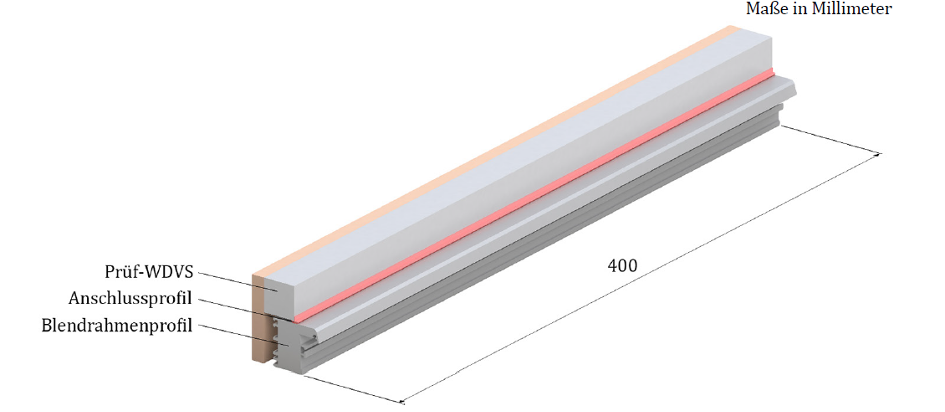
Schematic representation of a test specimen.
Temperature Change Loads
The temperature change loads are tested on a concrete test wall (1.8 x 2.0 m) with a window and ETICS installed. The window is installed with the building connections to be tested.
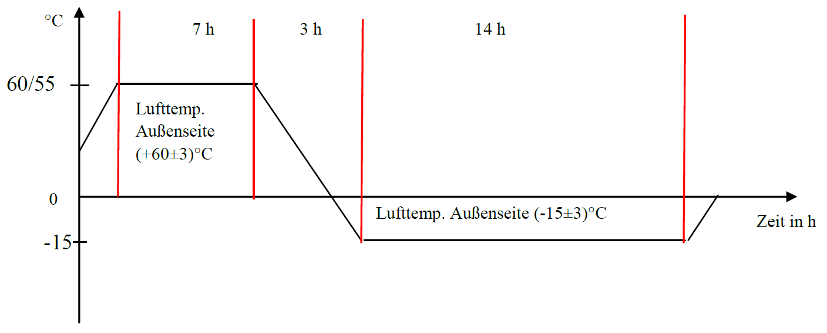
The test specimen is subjected to 10-15 cycles (depending on the standard or guideline) of temperature cycling (guideline M-01/1: +60°C /-15°C; ÖNORM 6400-2: +55°C/-15°C) on the outside. The inside is kept at room temperature. The building connection is examined for visible changes during the load.